
All categories
In order to facilitate reading and consultation online, we have created "web" (HTML) versions of several of the most popular leaflets and brochures in the literature of Alcoholics Anonymous. This format will be especially appreciated by those who use a telephone to browse the Internet. Download links for documents in PDF format are also available. Happy reading!
-

Conferences, Congresses and Gatherings
WHY AN AA CONFERENCE? It is clear that gatherings that extend beyond the confines of the group are now an integral part of AA life. The events calendar published in Box 4-5-9 or in the Grapevine announces certain AA conventions, conferences, or gatherings.
-

Processing Committees
The purpose of a Treatment Committee is to coordinate the work of AA members and groups who want to bring our message of recovery into treatment facilities and outpatient clinics and to build a bridge to "foster closer ties" between these facilities and a group in their AA community.
-

Correctional Committees
The Correctional Committee aims to coordinate the work of AA members and interested groups to convey our message of recovery to alcoholics behind bars, and to establish methods to facilitate the transition from the correctional facility to the AA community outside through pre-release contacts.
-

The publications committee
Today, just as in the early days of Alcoholics Anonymous, the AA message of recovery from alcoholism is passed from one alcoholic to another. However, since the publication of the first edition of the Big Book in 1939, publications have also played an important role in spreading the AA message and…
-

Collaboration with the courts and prevention programs
The sole purpose of this Twelfth Step work, then as now, is to carry the message of AA to the still-suffering alcoholic. To achieve this purpose, AA has learned to share information about AA with the courts.
-
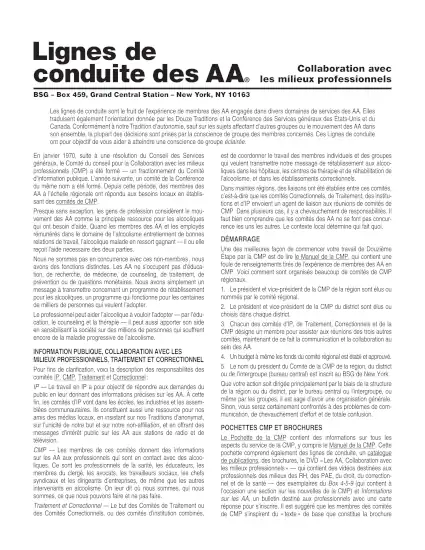
Collaboration with professional circles
The experience of A.A. has clearly demonstrated the usefulness of central/intergroup offices, especially in densely populated areas. There are nearly 700 central/intergroup offices worldwide, providing essential A.A. services. They form a network of A.A. services and contacts that help spread the A.A. message.